photo mosaic of Naples, Florida pier, Bayfront, Bayside, dolphin jumping, magenta orchid, water birds silhouetted against the sunset
I Might Have Some Trauma After This Deal

I Might Have Some Trauma After This Deal

Christian Ross | Ross Title – Ross Law

The Missing Tract: A Closing That Tested Everyone — and Still Closed (Mostly)
A listing agent we’ve worked with for more than a decade referred a seller to me and asked if I could step in to help get a deal to the finish line. Later, he told me this was the most challenging transaction he’s ever been a part of.

I took that as a compliment.

Not because anyone wants a hard closing — but because difficult closings are where professionalism matters. And because on every transaction, no matter how routine it seems, our process is the same: we start by searching for the problems that can ruin a deal.

Liens. Permits. Survey issues. And, of course, title. The reality is that my job can blur lines occasionally — attorney, counselor, problem-solver, traffic cop — but my priority never changes:

Convey marketable title.

Marketable Title vs. Insurable Title (What the Contracts Actually Require)

This distinction comes up more often than people realize — especially when a transaction is under pressure and everyone wants to “just close.”

Marketable title means title that is reasonably free from doubt and defects such that a prudent buyer would accept it, and the buyer can later sell or finance the property without facing a real risk of litigation or loss. It doesn’t mean “perfect,” but it does mean no meaningful cloud on ownership.

Insurable title is different – and much easier to achieve. It simply means that if there is a defect, a title insurance company is still willing to issue a policy (often with specific requirements, exceptions, indemnities, escrow holdbacks, or a claim being opened). In other words, the insurer is willing to backstop the risk, even though the record may not be fully cured.

Here’s the key point that many parties miss: Both NABOR and FAR/BAR contracts require marketable title — not merely insurable title.

So even if a title company is willing to insure over a defect, the contract standard still matters. We can’t simply look the other way because it feels practical in the moment. If we know there’s a legitimate cloud on title, the issue has to be addressed through curative work, a contractual solution, or (when necessary) a litigation path — not avoidance.

That’s exactly what happened here. Once we discovered a missing tract in the chain of title, we couldn’t unsee it — and we had to build a path to a responsible closing.

How We Found the Problem

Title work is not just “pulling a deed.” True title review is a disciplined process: canvassing every conveyance, lien, lawsuit, and recorded event affecting a property across decades, then confirming that the legal description and chain of title align cleanly from owner to owner.

In this case, that deep dive uncovered something that changed everything:

A deed recorded in 2005 was missing a portion of the property — specifically, Tract C — from the legal description.

Here’s the part that makes your stomach drop:

The seller’s current deed (the vesting deed) included Tract C.

But the deed immediately prior to them did not include Tract C.

The result was simple and devastating: Our sellers weren’t the owners of that piece of land.

That’s not a technicality. That’s not a harmless typo. That is the kind of defect that can derail a sale, trigger litigation, and put a buyer in the middle of someone else’s ownership claim.

How Did This Happen?

The honest answer is the hardest one: Everyone missed it.

The attorneys from the last closing missed it. The Buyer and Seller missed it. The issue sat quietly in the public records long enough to become “normal.” And yes — I’ll even say the quiet part out loud: I wish we had missed it too.

Not because ignoring problems is acceptable. But because once you see something like this, you can’t unsee it — and now you own the responsibility of solving it.

The Problem-Solving Phase

Once the defect was confirmed, we moved quickly through every viable option.

1) “Maybe Tract C was recorded somewhere else.”

Sometimes a missing parcel is the result of a separate conveyance or a mis-indexed instrument. We searched:

Collier County Clerk

Lee County Clerk

No luck. Tract C wasn’t hiding. It was missing.

2) “Maybe the prior attorney had an explanation.”

Sometimes there’s context: a scrivener’s error, a corrective deed never recorded, an agreement in a file drawer.

We reached out. There was no explanation — and no solution.

3) “Could title insurance help?”

Somewhat — but not in the simplistic way most people assume.

Title insurance can be part of the solution when a defect exists and the insurer is willing to insure over it (or accept a claim and indemnify against loss). But insurance is not the same thing as curing the public record — and it does not automatically convert a defect into “marketable title.”

Still, in the right deal, it can be one layer of protection while the true cure is being pursued.

4) “File suit.”

This would likely require a quiet title action, and depending on the facts, could involve an adverse possession theory or other equitable claims. The issue wasn’t that suit was impossible — it was time.

A lawsuit like this could easily take six months or more, and that’s assuming everything goes smoothly. And the longer the timeline, the smaller the chance this buyer sticks around. So we kept that as the last resort.

5) “Find the 2005 seller.”

This became the best remaining path: locate the party who still appeared to own Tract C and obtain a corrective conveyance.

The 2005 seller had passed away more than ten years ago.

But here’s the break that changed everything:

Her daughter — the successor trustee — was still living.

The Human Moment That Saved the Deal

At this point, the listing agent and I went full investigation mode. We tracked down a mailing address. Through a neighbor, we learned a phone number.

And then the best possible thing happened:

She answered the phone. Jackpot.

It didn’t solve the issue instantly, but it moved us from “theoretical options” to “a real person who might actually help.”

Where We Landed (As of This Article)

This is where the story ends… kind of.

As of the writing of this article:

  1. The daughter seems willing to sign, but she hired an attorney to guide her — which is understandable, but it introduced delays we didn’t have.
  2. The prior title insurance company accepted the claim and agreed to indemnify the buyer against damages that might arise from this defect. That didn’t cure title, but it created meaningful protection.
  3. The seller agreed to escrow funds to cover potential costs if a lawsuit becomes necessary, while also buying time to obtain the daughter’s signature.

With those layers in place — and after more than two months of relentless work — we closed.

  • The seller received all but 10% of their proceeds (held in escrow), allowing them to move forward with their life and their next home.
  • The buyer received their new home with a clear plan, multiple layers of protection, and a realistic path to resolve Tract C in the coming weeks — or worst case, months.
  • And just as importantly: everyone was paid.

Why This Closing Worked When It Shouldn’t Have

This deal didn’t close because the problem was small. It closed because the people involved refused to quit.

We pieced together enough of the puzzle to make a closing responsibly possible. Every piece mattered: persistence, creativity, communication, documentation, strategy, insurance leverage, and a willingness by both sides to stay solution-focused.

It’s not “done” yet — but it’s moving in the right direction.

Lessons Learned

1) Title issues don’t care how nice the house is. A beautiful home with a broken chain of title is still a broken deal.

2) “Insurable” isn’t the same as “marketable.” Insurance can help manage risk and create a path to closing, but the contract standard still requires a real plan to deliver marketable title — not a shrug and a signature.

3) Work with the best people you can find. None of the professionals in this story caused the defect. But the outcome depended on their skill and work ethic.

This property would not have closed if the buyer or seller had tried to save money by hiring a less competent Realtor, attorney, or title company.

Because when a deal gets hard — and some deals will — competence is not a luxury. It’s the difference between closing and collapsing.

NABOR Market Report | 2025 Year End

NABOR Market Report | 2025 Year End

Naples Area Board of REALTORS®

Housing Market Moved Toward Improved Stabilization in 2025

Naples, Fla. (February 17, 2026) – Housing market experts with the Naples Area Board of REALTORS® (NABOR®), which tracks home listings and sales within Collier County (excluding Marco Island), provided insight and predictions during its annual Year-End Conference at the Naples Conference Center on Monday, February 9, 2026. NABOR® members and inquiring citizens tuned in either in-person or via Zoom to better understand the Naples housing market during 2025 and to gain perspective of the market’s potential in 2026. The 2025 Year-End Conference slides and video are available on NABOR.com.

Are you seeking a home in the Bonita Springs – Naples, Florida area? Contact David at David@DavidFlorida.com or 239-285-1086.

I Might Have Some Trauma After This Deal

Multiple Offers – How Awful

Christian Ross | Ross Title – Ross Law

“I really hate multiple offer situations.” Who knew?!

I recently spoke to a REALTOR® who said, “I really hate multiple offer situations.” Was this was a confession of weakness? If you’ve ever actually managed one—ethically, transparently, and in a way that truly protects your customer—you know exactly why that comment resonates.

Multiple offers aren’t “hard” because the market is hot. They’re hard because the margin for error gets razor thin: one sloppy communication, one perceived favor, one unclear instruction from the seller, and you’ve got an ethics complaint, a licensing issue, a reputation problem, or all three.

Below are three real reasons multiple offer situations are stressful—and how to handle them without losing control of the deal.

1) Ethics: “Fair and equal” treatment… while still maximizing your customer’s outcome

The ethical tension in multiple offers is obvious: you owe duties to your customer, but you also have obligations about honest dealing and proper presentation of offers.

In Florida, license law specifically requires that offers and counteroffers be presented in a timely manner unless the customer has instructed otherwise in writing.

That sounds simple—until there are two, three, or twenty (!!) offers landing at once, each with different terms, deadlines, and escalation language.

The best way to stay clean is to systematize the process. A few practical guardrails:

  • Get the seller’s written game plan up front.
    Do they want:
    • highest and best by a deadline?
    • to counter only their top 2–3?
    • to accept first clean offer that hits a number?
    • to disclose “multiple offers” to encourage stronger terms (or not)?
      (This is strategy—but it needs to be the seller’s strategy, documented.)
  • Communicate one standard set of instructions to everyone.
    Same deadline. Same submission method. Same disclosure language. Same expectations.
  • Avoid “shopping” offers in a way that looks like favoritism.
    Multiple offers create a natural temptation to “work” one buyer harder than another. Even when you’re trying to serve the seller, uneven communication is how accusations start.
  • Document everything.
    When emotions spike, receipts matter. If someone later claims you didn’t present their offer or you steered the process, your paper trail is your best defense.

NAR also publishes guidance for REALTORS® on presenting and negotiating multiple offers, emphasizing protecting the client’s interests while staying within ethical and legal duties.

2) “Unfair dealing” perception—especially when you represent both sides (and that’s becoming more common)

Even when you do everything right, the perception of unfair dealing is almost guaranteed for the buyers who aren’t chosen—because losing feels personal in a bidding war.

That’s manageable when there are clearly separate agents on each side. It becomes far more volatile when the listing agent ends up involved with the buyer side too (whether as a single agent, transaction broker, or even no brokerage relationship).

And yes—this is a conversation that’s growing louder because of the post-settlement environment. Several industry observers have predicted an increase in dual agency / one-agent transactions as commission structures and buyer-representation behavior shift.

Whether true or not, this is where complaints come from.

3) Managing the seller’s expectations (before they get entitled)

Multiple offers can also inflate the seller’s ego. It happens fast:

  • The seller starts believing every request is unreasonable because “we had ten offers.”
  • They become less cooperative on inspections because “buyers should feel lucky.”
  • They expect the deal to be painless because “we’re holding all the cards.”

Then the inspection hits—and reality returns.

A strong listing strategy includes training the seller that the “best offer” is often the one most likely to survive inspections and financing. Also, if the seller becomes rigid or punitive, they can turn a strong contract into a failed transaction.

If you don’t set that expectation, multiple offers can create an ungrateful seller problem: they got the number they wanted, and now they refuse to do anything reasonable to keep the deal together.

4) Backup offers: helpful tool, but only if everyone understands what they are (and what they are not)

A backup offer is not “almost under contract.” It is a real contract in second position, typically contingent on the first contract terminating.

Backup offers can be valuable because:

  • they reduce the seller’s downtime if the first deal collapses,
  • they keep leverage on the primary buyer (sometimes),
  • they provide an orderly Plan B without re-listing chaos.

But they also create risk if poorly explained.

5) The MLS status issue: can you keep the listing Active while under contract if everyone “agrees”? No.

This is where a lot of agents get tripped up, especially when a seller wants to “keep it active to collect backups.”

At least in Naples (NABOR’s MLS guidance), the rule is blunt:
“Under no circumstances can a property that has a contract on it be left as Active. Even if the sellers are accepting backup offers, the home must be placed in pending or pending with contingencies status.”

And status changes must be timely—NABOR MLS rules require status updates (e.g., pending to closed, etc.) within a defined window (commonly referenced as three business days).

So even if the buyer and seller both say, “We want it to stay Active,” that agreement does not override MLS compliance rules. The MLS is not a private marketing preference; it’s a rule-governed database.

Closing thought
If you run a multiple offer situation like a system—clear seller instructions, equal communications, tight documentation, sober expectations on inspections, and clean backup offer handling—you don’t just “win the deal.” You reduce the risk of the deal (and your reputation) unraveling after the excitement wears off.

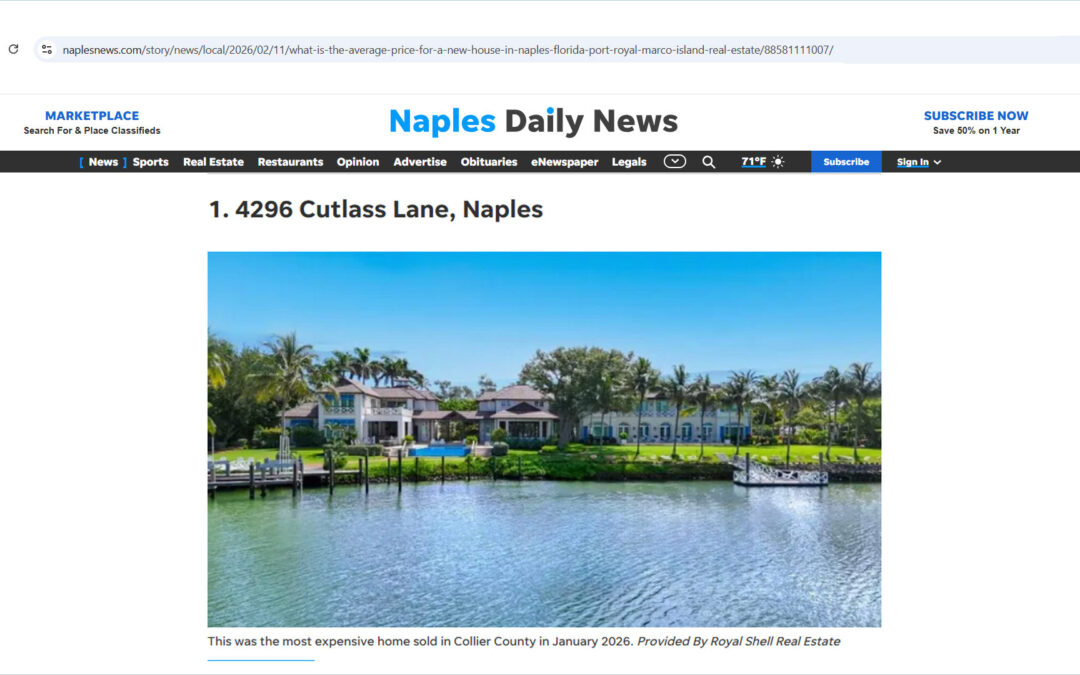
$55M Naples house tops January list of most expensive homes sold

$55M Naples house tops January list of most expensive homes sold

Mark H. Bickel | Fort Myers News-Press & Naples Daily News

These are the Top-10 most expensive homes sold in Collier County for January 2026. Data provided by Royal Shell Real Estate.

1. 4296 Cutlass Lane, Naples

  • List price: $60,000,000
  • Sold price: $55,000,000
  • Neighborhood/Development: Port Royal
  • Size: 15,309 square feet
  • Year built: 2017
  • Days on market: 56
  • Amenities: Bayfront, Boat Dock/Lift, Private Pool/Spa, Built-In Grill
  • View: Bay

Read the full article with property photos on naplesnews.com.

Ready to explore the most exceptional properties of Southwest Florida? Contact me today to begin your journey. Contact David at David@DavidFlorida.com or 239-285-1086.

NABOR Market Report | December 2025

NABOR Market Report | December 2025

Naples Area Board of REALTORS®

December Home Sales Shows Market Confidence & Stability

Naples, Fla. (January 23, 2026) – Overall closed sales in Naples during December increased 28.8 percent to 773 closed sales from 600 closed sales in December 2024. Broker analysts reviewing the December 2025 Market Report by the Naples Area Board of REALTORS® (NABOR®), which tracks home listings and sales within Collier County (excluding Marco Island), have been watching closed sales improve for seven months consistently. They believe the increase in sales is largely due to sellers being more willing to negotiate. Adjustments in prices – as a result of seller flexibility – effected a 2.5 percent decrease in the overall median closed price in 2025; and a 5 percent decrease in December to $570,000 from $600,000 in December 2024. With 8.3 months of inventory available to buyers heading into 2026, broker analysts are cautiously optimistic that closed sales will continue to increase as our transition to a more balanced market is ideal for homes sales in Naples.

Paradise Preferred

Sales in the Naples luxury home market – $1.5 million+ – continue to outpace closed sales activity in other price categories. Most remarkable, the December report showed closed sales of properties over $5 million increased 16.6 percent during 2025.

According to the report, overall pending sales increased 12.5 percent in December to 704 pending sales from 626 pending sales in December 2024.

“We had almost the exact number of pending sales in 2025 as we did in 2024 [10,178 vs. 10,090],” said Mike Hughes, Vice President and General Manager for Downing-Frye Realty, Inc. “But if you look at the number of pendings [10,178] compared to closings [8,249] in 2025, you can see that there were still a considerable number of sales that fell through. Sellers need to be aware of this because if a buyer comes back with a request, it may be in the seller’s favor to address their request and negotiate rather than allow the deal to fall through.”

Overall inventory during December decreased 3.8 percent to 5,714 properties from 5,938 properties in December 2024. Inventory in December decreased the most in the 34116 zip code, 30.1 percent. This area also reported the highest closed sales for the month, a 155.6 percent increase.

Condo Grab

While the number of properties available under $300,000 has slowly declined in the last few years, the December Market Report showed the inventory of condominiums under $300,000 has been on the rise, leading to a 28.4 percent increase in closed sales of condominiums in this price category for December. Overall inventory in the condominium market in December increased 1.2 percent to 3,088 condominiums from 3,050 condominiums. An increase in condominium sales is anticipated in the first quarter of 2026 because condominium inventory under $300,000 increased 47.5 percent in December.

The NABOR® December 2025 Market Report provides comparisons of single-family home and condominium sales (via the Southwest Florida MLS), price ranges, and geographic segmentation and includes an overall market summary. NABOR® sales statistics are presented in chart format, including these overall (single-family and condominium) findings for 2025:

NABOR Market Report December 2025 chart

New Conversations

According to several broker analysts reviewing the December report, conversations in 2026 will look much different than in previous years because last year proved hurricanes are not an annual threat, insurance rates are now more competitive – Citizens Property Insurance Corporation, a not-for-profit insurer of last resort that was created by the Florida Legislature in 2002, just lowered its rates – and mortgage rates hovering around 6 percent are increasingly considered the new normal and will likely remain for the immediate future.

Are you seeking a home in the Bonita Springs – Naples, Florida area? Contact David at David@DavidFlorida.com or 239-285-1086.

How long does it take to sell a house in Naples, FL? What to know for buyers and seller

How long does it take to sell a house in Naples, FL? What to know for buyers and seller

USA TODAY Network

The median home in Collier County listed for $729,725 in December, up 1.2% from the previous month’s $722,900, an analysis of data from Realtor.com shows.

Compared to December 2024, the median home list price decreased 5.8% from $775,000.

The statistics in this article only pertain to houses listed for sale in Collier County, not houses that were sold. Information on your local housing market, along with other useful community data, is available at data.naplesnews.com.

Collier County’s median home was 1,816 square feet, listed at $415 per square foot. The price per square foot of homes for sale is down 5.5% from December 2024.

Learn more on naplesnews.com.